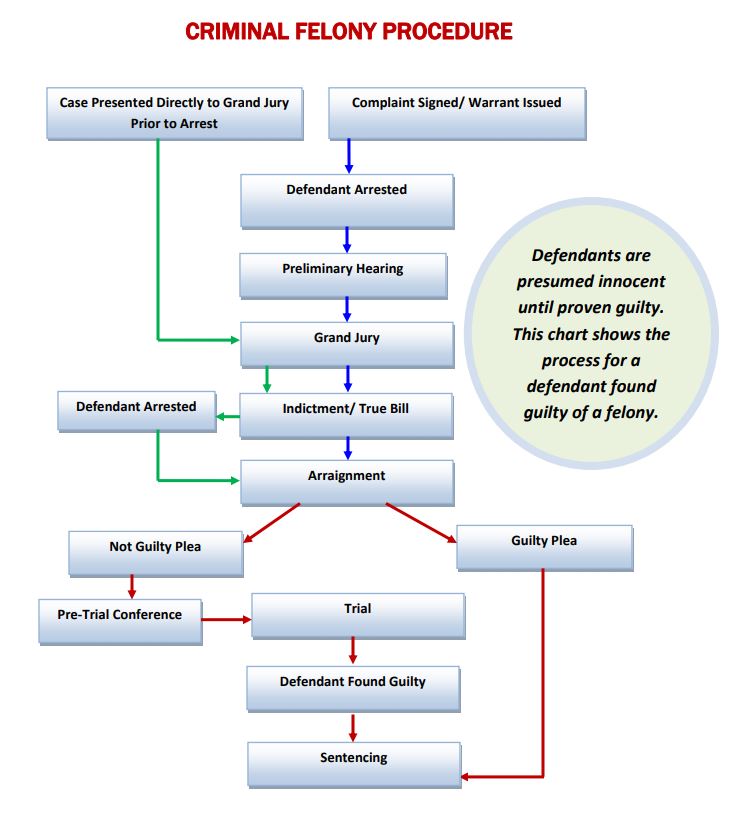
This is a probable cause hearing. Probable cause refers to the burden or level of proof required to maintain charges against the Defendant.
Probable cause is proof that it is more likely than not that a Defendant committed the crime for which he/she is charged.
A defendant is entitled to a preliminary hearing within 21 days of request. The request must be made within 30 days of arrest.
If a defendant does not request a preliminary hearing, or fails to appear for the hearing, the defendant has waived his/her preliminary hearing and the case is forwarded to the Grand Jury.
If probable case is found the case is bound over to the Grand Jury.
If no probable case is found the case is dismissed but may be presented to the Grand Jury.
The preliminary hearing gives the defendant and his/her attorney the opportunity to hear a portion of the evidence the State has against the defendant in the case.
This is the process through which most felony cases must pass in order to take a felony case to trial.
Citizens of Alabama have a constitutional right to have any felony charges presented to the Grand Jury
A Grand Jury is randomly chosen pool of 18 qualified venire members
This is also a probable cause hearing
Typically, only the case agent presents evidence to the Grand Jury. However, any witnesses can be called to testify before the Grand Jury.
A defendant does not have a right to testify personally or present witnesses to a Grand Jury. He/She may request to appear and testify and, if the State allows such request, the defendant may not have counsel present during his/her testimony.
The Grand Jury may vote to True Bill or No Bill a case.
True Bill or Indictment:
If at least 12 Grand Jurors vote to indict a case, the case is true billed. This means that the case will proceed to Circuit Court.
An Indictment is the charging instrument through which a defendant may be tried.
The indictment is intended to notify the defendant of the charges against him/her so that he/she may adequately prepare to defend himself/herself against the charge.
No Bill:
If less than 12 Grand Jurors vote to indict a case, the case is no billed. This means that the case will not be further prosecuted.
However, if additional evidence is discovered at a later time that was not presented to the Grand Jury, the case may be presented to a new Grand Jury with the new evidence.
Guilty- after entering a plea of guilty, a defendant would be set for a sentencing hearing.
Not Guilty- this is the most common plea entered and after entering a plea of not guilty, the court schedules a trial date.
Trial
Every defendant charged in an indictment for a felony charge has a constitutional right to a trial by jury.
A jury is made up of 12 jurors qualified venire members.
To find a defendant guilty, the 12 jurors must reach a unanimous verdict finding of guilt beyond a reasonable doubt.
To find a defendant not guilty, the 12 jurors must also reach a unanimous verdict of not guilty beyond a reasonable doubt. This is not the same as a finding of innocence.
When a defendant is found guilty, the court schedules a sentencing hearing.